Have you ever wondered why some industrial structures last for decades while others fail prematurely at the joints? In heavy manufacturing, the structural integrity of your entire project often hinges on the quality of a single weld. When dealing with highly aggressive chemical or outdoor environments, selecting the correct stainless steel welding rod is your frontline defence against destructive failure.
Corrosion costs global industries billions annually and a significant portion of this damage starts directly within welded seams. If the filler metal fails to match the properties of the parent material, localised degradation can take hold rapidly. Learning how specialised consumables shield your builds from these harsh environments is vital for any commercial operation aiming to deliver long-term reliability.
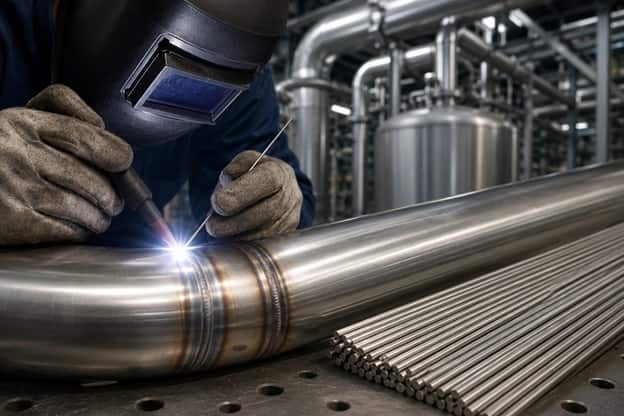
Why Welds Are Vulnerable to Corrosion
Welding alters the microstructure of metals through intense heat. This thermal cycle triggers a chain reaction that compromises the alloy protection:
- Chromium Carbide Precipitation: The extreme heat causes sensitisation, where chromium combines with carbon at the grain boundaries, depleting the protective chromium content.
- Loss of Oxide Layer: Due to this drop, the stainless steel loses its natural ability to form a protective oxide film.
- Low Carbon Protection: Using a high-quality stainless steel welding rod prevents this issue because these consumables feature low carbon content or stabilising elements like niobium or titanium.
- Resisting Chemical Attacks: Keeping carbon levels minimal allows the chromium to remain free to fight off oxidation.
- Matching Metal Properties: Selecting the right rod ensures that the weld metal matches or exceeds the corrosion resistance of the base metal.
- Preventing Cracking: This choice directly protects the finished component from stress corrosion cracking and intergranular attacks.
Addressing these thermal vulnerabilities during the initial planning phase ensures that your joints remain as resilient as the surrounding metal.
Technical Material Selection in Heavy Industry
Engineering teams often manage projects that combine different metals or require retrofitting older machinery. For instance, a project might involve joining stainless steel components to heavy machinery bases made of cast iron.
In these mixed-metal scenarios, using the wrong consumable leads to rapid failure. While you would use a stainless steel filler for standard production, repairing the heavy base requires cast iron welding electrodes to ensure a strong, crack-resistant bond.
Every alloy demands specific chemical properties to withstand industrial stress. Using the correct electrode prevents brittle zones from forming between the two distinct materials. Proper selection guarantees that the joint can handle both mechanical loads and environmental exposure without cracking.
Optimising Sourcing for Engineering Integrity
Achieving flawless, corrosion-resistant welds requires absolute trust in your consumables supply chain. Forward-thinking businesses look for a single partner to streamline operations. Sourcing from a one-stop shop for all stainless steel consumables eliminates operational friction.
Choosing a manufacturer like Superon Technik ensures access to high-performance stainless steel welding rods designed for reliable, corrosion-resistant and precise welding across industrial environments. These stainless steel welding electrodes deliver exceptional durability and consistent weld quality for manufacturing, maintenance and stainless steel joining applications. Their commitment to consistent quality ensures stress-free usage for all your assembly needs.
Operational efficiency is further supported when a supplier provides easy availability across India. This gives industrial buyers multiple purchasing options from local networks without delays.
By working with a single, comprehensive vendor, traders can treat them as a sole partner for all their needs. This collaborative approach means businesses do not have to commit to multiple dealerships or complex minimum order quantities.
Best Practices for Workshop Corrosion Prevention
To get the best results from premium consumables, workshop teams must follow strict material hygiene practices:
- Isolate Working Zones: Always isolate stainless steel assembly areas from carbon steel dust because cross-contamination from airborne iron particles introduces localised rust spots on brand-new surfaces.
- Control Heat Input: Manage the heat input during the welding process since high heat slows down the cooling rate and increases sensitisation risks.
- Maintain Settings: Using the correct current settings and maintaining proper interpass temperatures will preserve the corrosion-resisting properties of the alloy.
- Post-Weld Cleaning: Clean the metal thoroughly after welding because passivating the area removes heat tint and restores the chromium oxide film that protects the steel from environmental moisture.
Implementing these specific workshop habits maximises the protective chemistry of your chosen filler metal and prevents premature surface degradation.
Conclusion
Preventing corrosion failures requires premium materials, proven techniques and a reliable supply partner. Ensure your project maintains its integrity by using consistent welding consumables. Sourcing reliable alloys protects your industrial assets from premature breakdown while significantly lowering long-term maintenance costs. Adopting standard material protocols transforms unpredictable manual welding into a controlled, repeatable process that consistently meets strict engineering specifications.